
Google Reviews
Insurance Accepted
Treatment Plans

Maybe you’ve noticed that you get winded more easily than you used to. You may have a persistent cough, wheezing, chest tightness, or find that everyday activities leave you short of breath.
Breathing changes can happen for many reasons, but understanding how your lungs are functioning can provide valuable information. At Allhealth Medical, our Spirometry Testing measures airflow and lung function, giving your provider objective information to help evaluate breathing concerns and determine whether additional care may be appropriate.
Spirometry is a pulmonary function test that measures how much air you can breathe in and out and how quickly you can exhale. These measurements give your healthcare provider valuable information about how effectively your lungs are functioning
Helps determine how much air your lungs can move during a full breath.
Measures how quickly and effectively you can move air out of your lungs.
Abnormal results may help your provider evaluate conditions that affect airflow and lung function.
Repeat testing can help your provider track changes in lung function over time and evaluate how you are responding to treatment.
Your healthcare provider may recommend spirometry if you are experiencing breathing symptoms, have certain risk factors, or need ongoing monitoring of a respiratory condition.
Feeling winded or having difficulty getting enough air.
A persistent or recurring cough that may warrant further evaluation.
Symptoms that may be associated with narrowing or irritation of the airways.
Spirometry may sometimes be used to evaluate lung function before certain procedures or as part of a broader respiratory assessment.
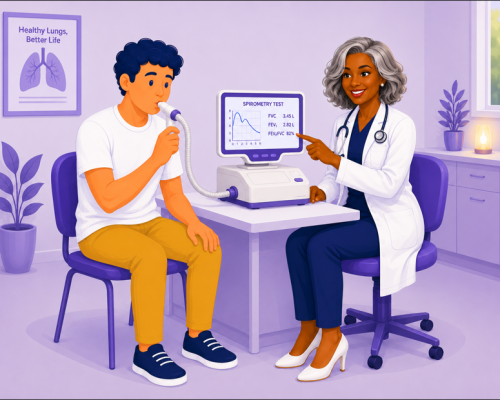
1. Preparation
Your healthcare team will explain the test and how to perform it correctly. You may be asked about your medications, smoking history, recent illness, or breathing symptoms before testing begins.
2. The Test
You will sit comfortably and breathe through a mouthpiece connected to the spirometry equipment. A nose clip may be used so that all of your air passes through the device.
You will be instructed to take a deep breath and then blow out as hard, fast, and completely as you can.
3. Repeat
The test is usually performed several times. Repeating the test helps ensure that the measurements are consistent and reliable.
The entire process is generally completed within a short office visit.
4. Results
Your healthcare provider will review your measurements and explain what they may mean in the context of your symptoms, medical history, and overall health.
Spirometry provides objective measurements of your breathing and lung function. Your provider may review measurements such as:
FVC — Forced Vital Capacity
The total amount of air you can forcefully exhale after taking a full breath.
FEV₁ — Forced Expiratory Volume
The amount of air you can forcefully exhale during the first second of the test.
FEV₁/FVC Ratio
A comparison of these measurements that helps your provider evaluate your airflow.
Your results are compared with expected values based on factors such as your age, height, and sex and interpreted alongside your symptoms, medical history, physical examination, and other clinical findings.
These results may help your provider determine whether additional evaluation is appropriate, monitor changes in lung function, assess response to treatment, or make adjustments to your care plan.
Google Reviews
Insurance Accepted
Treatment Plans
